When a Foster Dog Leaves

scrappyA foster dog never leaves my home. Their memories are forever embedded in my heart. I look at their favorite spots, whether it be on the couch or in the yard, and it reminds me of their happiness. I provided a temporary, but very stable, nurturing home. They had gotten bathed in my tub to wash off the shelter filth, a different collar to give them a new identity, food, water, and a comfortable place to sleep. They played with an abundance of toys, received numerous treats and bully sticks, and were on schedule of two working humans, looking to give back and make a difference in the world. The foster dog gets its pictures and biography posted online and volunteers await applications, ready to begin reference and background checks. Meet and greets take place to see if the dog will be a good fit for the new person or family. If all goes well, the foster dog leaves to its furever home. I feel a mixture of emotions when my foster dog leaves, which I can compare to a cocktail; two parts happiness mixed with one part sadness, topped off with worry, shaken with relief, and poured into a half-full glass.

I am happy, because they have a new home.

I am sad, because they are leaving me. My labor of love ends.

I am worried, for the next 48 hours, hoping they adapt well to their new person/family and environment.

I am relieved, that I had a helping hand in making my foster dog an adoptable canine companion.

Before I meet with the potential adopters, I always spend some alone time with my foster dog. I pray that they always be cared for and loved. I give them a treat, belly rub, and kisses. I tell them I love them and was happy to be given the opportunity to take care of them. I let them play with Bailey, my 2-year-old rescue, in the yard, one last time.

I reflect on their progress. They arrived broken and leave mended, by life’s greatest virtue: love.

farrahWhen the adopters arrive, I appear nonchalant, but secretly, my insides ache. My heart drops into my stomach. I hold tears back from streaming down my face. I remind them that if it doesn’t work out, to call me, and I will take the dog back, no questions asked. The dog that doesn’t want to leave my home is the most painful to watch. I turn away, or the composure I work so hard to maintain will be lost. I enjoy watching the dog that leaves confidently, as I often wish I could tackle new adventures as fearlessly as they do.

As my foster dog is leaving my care, I must repeat to myself:

The next dog you rescue will probably be worse than this one. They need you. Let this one go.

This dog is going to a happy, healthy home. It will work out. Be positive.

I can’t keep all the dogs I rescue, so continue fostering, educating, and advocating.

Dogs come into our lives to teach us about love. When they depart, they teach us about loss and acceptance. New dogs never replace the previous, they only expand our hearts and allow us to grow. Every dog I foster comes with a story, I just hope to give them the happiest of endings; a perfect forever home.


Play Dead

“He should be in the ASPCA commercial, he would bring in all the donations!”

“Your cats are friendlier than your foster dog!”

20161225_150419“Can I adopt your dog? She’s great!”

I have never witnessed anything like it in my life.

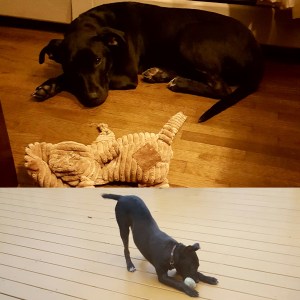
I told the potential adopter that Heath, my 10-month-old black lab mix, was shy and scared. I told him that he has irritated skin, probably from stress, and comes with an antibiotic and a medicated shampoo. I was honest and upfront about all of Heath’s qualities. He needs work. As do most people in the world (hello, blogging & wine).

His background, I don’t know and can’t even imagine. When I get a foster in his state (scared, submissive, untrusting), I formulate stories in my head. My story of Heath was that he was rescued down South, spent most of his time in a crate and away from people, and that his interactions with people were limited or not pleasant. He knows what a ball is, and plays appropriately with toys, so that leads me to believe he had some interaction… but he cowers when I pet his head, and he still waits to see how I interact with Bailey before he comes and approaches me. It took me 40 minutes to lure him out of the crate the first night he arrived, but now, his hiding spot is underneath the kitchen table. He comes out from hiding on his terms in his time. Baby steps.

The potential adopter sent me a text message saying that he would arrive in 5 minutes, in which I began to give Heath a long pep-talk. It went like this: “You got this buddy. You want to go home for Christmas. You can do it. These are nice people, good people, and they are going to love you, and you are going to love them. You need to put on a good show. Now is your chance, Heath. I will be right here with you. ”

The potential adopter and his family came into my living room. Heath army crawled around on the couch and then he ran and hid underneath my kitchen table. I retrieved him from under the table and I tried placing him in the potential adopter’s lap. No cigar. Heath wanted off and out, now. I tried encouraging Bailey to play with him. I tried to get him to play with a toy. I tried to give him treats. I tried bringing the cats around so he could chase them. Something. Anything. I think I burned holes through my sweatshirt running around trying to figure out how to get him to do SOMETHING other than be scared and sad.

Then, Heath actually did something. He rolled on his back and exposed his white chest, put his front paws in the air, closed his eyes, and played dead. He couldn’t handle the meet and greet. He wanted our eyes off of him. He gave me the something I so desperately wanted. He laid on my floor, motionless, as if to say, “Is this over yet? Because I’ve had enough. My eyes bulged out of my head, my mouth was wide open, and my rosacea-like cheeks turned a new shade of pink. I opened my palm, slapped it against my forehead, and said “He is just really submissive.” Face palm. Foot in mouth. FML.

The potential adopter and I exchanged awkward pleasantries along the lines of sorry for wasting your time and I’ll let you know if a dog comes along that is a little more outgoing. Heath needs to work on his socialization skills, which requires a lot of time. There was unfortunately no connection between Heath and the potential adopter. There was, however, me, the foster parent, running around like an idiot trying to get Heath to be someone he is not…

img_20161223_185734_569

I talked to Jason (who wasn’t home to witness the playing dead drama), my mom, sister, and people from the rescue who couldn’t believe that it happened. They laughed, said “Oh no!,” and gave me some helpful advice.

I laugh, because I think of the everyday situations in which I wish I could play dead like Heath. I would just lay on my back with my legs and arms in the air, close my eyes and be like “F this shit, I’m done.” I thought it was funny and sad, all at the same time. Funny because that was his time to shine! I gave him a pep talk! We discussed this! And, what does he do? Play possum. It’s sad because God only knows what has happened to him to have him shut down and play dead. I feel like my life has so many of those funny-sad moments. I could relate to Heath, the days that I just stay in bed and mutter to myself “Nothing can happen to me here.” I think if I played dead in the middle of the rehab gym or in the middle of Jason talking to me, it wouldn’t be socially acceptable as I am not a canine, but it would make for a very interesting story.

Doors open and close each day in our lives. Heath decided to play dead when an opportunity was wide open for him to be adopted into a forever home. But I think Heath playing dead had a bigger meaning. He’s content here, he’s slowly becoming more comfortable, and maybe, he knew he is just not ready to leave.

20161223_211714Heath will find a home. He will find a person or family that will understand him and his quirks, that will accept his shyness and love for his hiding spots. Heath is an amazing little fellow. He observes from afar, licks your hand, takes treats nicely, and isn’t afraid to be himself. He perks up when he sees me take out a leash and enjoys his kibble with chicken and cheese.


When life gets tough, don’t be afraid to play dead.  The right door will open when you least expect it and in the interim, you’ll have the opportunity to work on your quirks.

You got this, Heath. I’m with you every step of the way.

Namaste.

Color Vibe


welcomecolor

When I was interning as an occupational therapy student in TBI (traumatic brain injury), I had an extremely difficult client who wouldn’t engage in conversation, never mind participate in any of the activities I presented to him. He became increasingly agitated and would smack himself, pound his fists on the table, and shout obscenities at me, disturbing the other therapists and clients. In school, they don’t teach you how to handle these types of situations. Your CI (Clinical Instructor) wants you to think on your feet and watch you adapt to a plethora of uncomfortable, unpredictable situations. They want to see how you keep control of your patient and the dilemma, and observe how you handle stress and aggravation. Fortunately, in this situation, my childhood hobby came into handy.

I knew my client liked Star Wars, so I printed out a few coloring sheets on the computer. I walked over to him, placed a coloring sheet and a box of crayons on the table in front of him, and sat down a few feet away. He looked at me and screamed, “I AIN’T DOIN’ THAT, STUPID!” I defeatedly replied, “Okay.”, and I started coloring my own sheet. After a few minutes, I saw him reach for a crayon. He colored the entire sheet, quietly, without outbursts. Everyone in the room was shocked. I remember one therapist gave me a thumbs up.  I finally got him to engage in a task and act appropriately for thirty minutes. When he finished with the first sheet, he asked me if I had any others. Mission accomplished.

Now, as an occupational therapist, I keep a few coloring books on hand in the therapy gym. I have learned more about my clients when they are coloring and having a bad day than I have trying to get them to do other activities of daily living (ADLs are the basis of OT including dressing, toileting, grooming, hygiene, bed mobility, medication, and home management). Sometimes, as they are coloring, I can get to the bottom of why my client is feeling a certain way, and what may be causing them to have a bad stint in the gym. Life, as we all know, certainly does happen, and sometimes we need to do something relaxing before we jump into more difficult tasks.

color-dogs

work in progress

If you don’t already know, coloring has numerous therapeutic benefits. When my anxiety creeps up, I whip out this small coloring book, 12 Crayola twistable colored pencils, pour myself a nice big cup of coffee, and start coloring. Coloring calms me down, helps me to de-stress, unwind, and unplug. It’s tactile, and I get to choose my color and sheet, which gives me control. I am happy when my page is finished. I don’t stress if I color outside the lines. I could care less if I doodle in the background. Sometimes, I use one or two colors and sometimes I use all twelve. It is creative, quiet, and fun.

As silly as it may sound, coloring is my coping mechanism and a great way for me to self-soothe. It is cheaper than therapy, healthier than a glass of wine, and allows me to retreat to my own personal paradise.

After all, broken crayons still color.

Namaste.

colorowl